
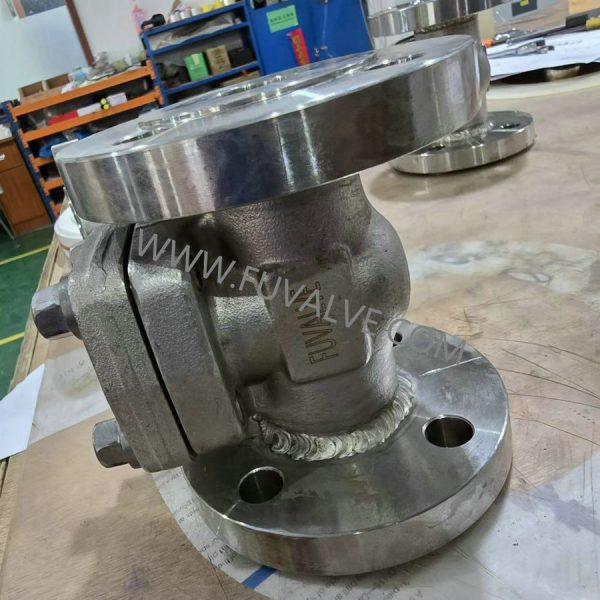


Plug Type Ceramic Check Valve
- Description
- Inquiry
Plug Type Ceramic Check Valve
Specification
| Type | Plug Type Ceramic Check Valves |
| Size | DN50-DN300(1”-12”) |
| Pressure Rating | PN10,PN16,PN25,PN40, PN63, PN100, PN160, CL150, CL300, CL600, CL900 |
| Body Material | WCB, CF8, CF8M, CF3M, Hastelloy, Monel, Alloy 20, Titanium |
| Trim Material | ZrO2 Ceramics, Al2O3 Ceramics, Tungsten Carbide, Si3N4 |
| End Connection | Flange End, Butt Welding End, EN1092-1, DIN 2501, ASME B16.5 |


Typical Applications:
For common metal seated plug type check valves, the metal seat and disc sealing face is easily to be getting damaged if the medium is corrosive and / or abrasive. Plug type ceramic check valves were developed by FUVALVE to solve these severe corrosion and abrasion problems. Plug type ceramic check valves are widely used in many aggressive applications, such sea water, corrosive slurry, Metallurgical slurry, paper making slurry, ect.
Plug Type Ceramic Check Valve
Product type
Based on common structure of globe valves, Plug type ceramic check valves also have several body structures for customers’ special requirements:
Generally there are straight pattern, angle pattern, Y pattern, bolted bonnet design for plug type check valves, and these structures are all available for FUVALVE Plug type ceramic check valves.
Only suitable for horizontal installation.
Variable ceramic trim, including ZrO2 ceramics, Al2O3 ceramics, silicon nitride, tungsten carbide. Which makes sure the Plug type ceramic check valves have excellent abrasion resistance and corrosion resistance.
Ceramics to ceramics seated. Flat or Spherical seat face and conical ceramic disc ensure all the Plug type ceramic check valves are zero leakage.
One piece body and bonnet.
Plug Type Ceramic Check Valve
Temperature range
Depends on the material used for Plug type ceramic check valves, the normal working temperature is -29~250 degree.
Valve tightness
The disc and seat sealing face are well polished, all the ceramic globe valve have tight shut off properties. The leakage class is up to Class VI.
Design Standards
Valve body design: BS 1873
Face-to-Face Dimension: ASME B16.10
Butt weld End: ASME B16.25
Flange Ends: ASME B16.5, EN 1092-1
Valve Testing: API 598
1. Corrosion Resistant:
Cold Isostactic Pressing (CIP) and high-temperature sintering nanometer high-purity 99% Al2O3 and 99.7% Al2O3 (alumina) and ZrO2 (zirconia) ceramics will not interact with almost all organic and inorganic chemicals, nor contaminate process medium. Their physically and chemically stability against most acids, salts and alkalis will last for many years with little or no corrosive degradation, which make sure that Floating Ceramic ball valve have excellent performance in corrosive applications.
2. Abrasion Resistant:
The hardness of 99% alumina ceramics is about HRA88, harder than zirconia (about HRA85), solid tungsten carbide is about HRA 90,which is about 8 times harder than stainless steel. As valve trim, ceramic components make Floating Ceramic ball valve work well in the most severe abrasive conditions, such as pneumatic conveying to transport silicon powder, coal powder, Mg powder, etc.
3. Ceramic-to-Ceramic spherical seated:
The perfect fine grinded spherical seal between ceramic ball and seat ensure a Class VI shutoff. The anti-scratch design between disc and seat, which prevent sealing surface from being scratched by particles. The ceramic ball will not be stuck so ball will not be broken.
Temperature range
Depends on the material used for Plug type ceramic check valves, the normal working temperature is -29~250 degree.
Valve tightness
The disc and seat sealing face are well polished, all the ceramic globe valve have tight shut off properties. The leakage class is up to Class VI.